

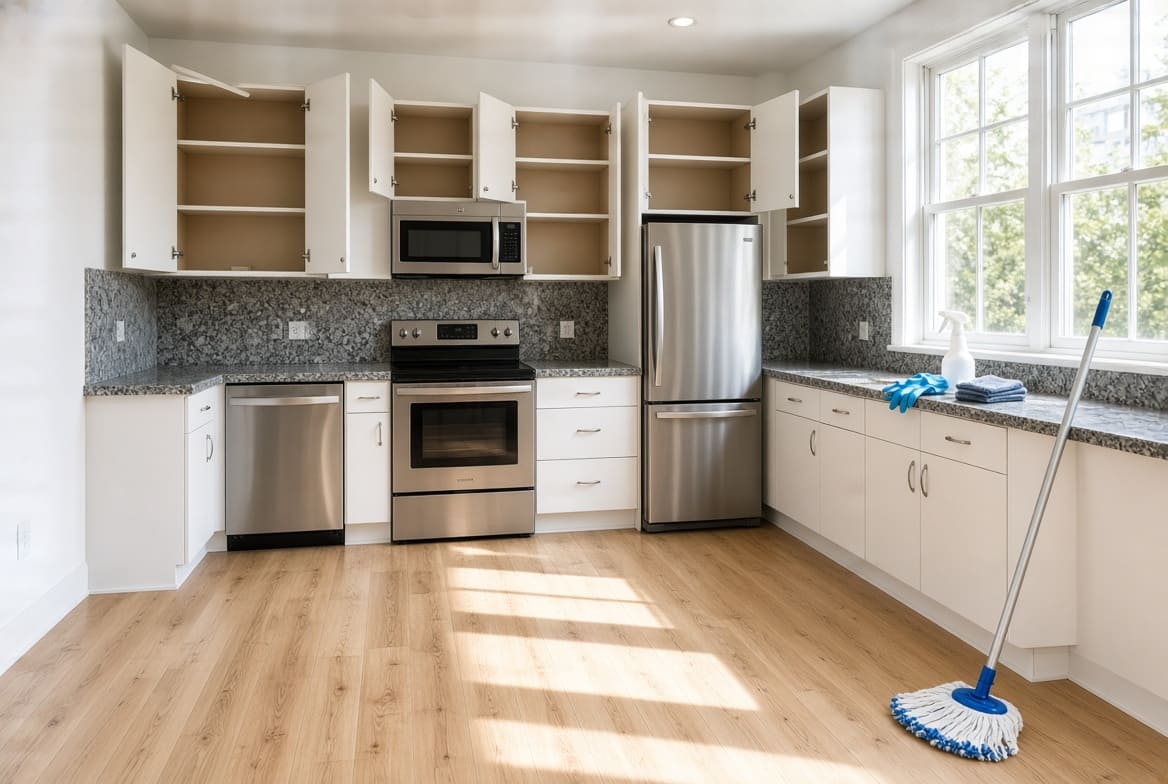
- California law asks you to return the unit to the same level of cleanliness it had when you moved in, minus ordinary wear and tear. That is the whole standard.
- From April 2025, your landlord must photograph the unit after you leave and again after any cleaning they bill you for, and send those photos with the itemized statement.
- Requesting the pre-move-out inspection is the highest-value 20 minutes of the entire process. The list you receive becomes your cleaning plan, and items left off it are generally off the table later.
- Deductions above $125 require receipts or invoices, and the full package has to reach you within 21 days of you handing back possession.
- Your own timestamped photo set, shot on an empty unit right before you drop the keys, is what decides a dispute.
- A professional move-out clean in Los Angeles typically runs $200 to $450 for an apartment, which is usually less than a single contested cleaning charge.
What Your Lease Asks For and What the Law Allows
Most tenants clean far past what they owe and still lose money, because they clean the wrong things and document none of it. Civil Code 1950.5 is short and specific about what a deposit covers: unpaid rent, cleaning the unit to the level of cleanliness it had at the start of your tenancy, and repair of damage beyond ordinary wear and tear. That is the full list. Everything else your landlord writes into a move-out packet is a preference, not an obligation.
The standard is move-in clean, not brand new
If the oven had baked-on residue in the corners the day you got the keys, you are not required to hand back a factory-fresh oven. If the grout was dingy then, dingy grout now is not a chargeable condition. This matters because it changes where you spend your Saturday. Focus on what you added: grease, soap scum, dust, hair, food residue, scuffs from furniture, and anything with an odor.
Tenants who kept a move-in checklist or took photos on day one have a real advantage here. If you did not, you are not out of luck, but you will be arguing from a weaker position, so plan to clean a little past the line rather than right on it.
Professional cleaning clauses are weaker than they look
Plenty of Los Angeles leases still say the tenant must hire a professional carpet cleaner and produce a receipt. As of January 2025 the statute spells out that you cannot be charged for professional carpet cleaning unless it is reasonably necessary to bring the carpet back to move-in cleanliness, setting aside normal wear. A blanket clause that charges you regardless of condition conflicts with the statute, and 1950.5 cannot be waived by lease language.
The practical read: if your carpet is genuinely soiled, pet-stained or smells, get it cleaned and keep the receipt. If it just looks like carpet that had a person walking on it for 2 years, vacuum thoroughly and photograph it.
Wear and tear is not dirt
Faded paint, small nail holes, worn traffic lanes in carpet, minor scuffs on a wall, loose grout, and sun-bleached blinds all sit on the wear side. Grease film on cabinet doors, mildew in a shower corner, a fridge with spills in it, and cigarette or pet odor sit on the tenant side. Sorting your list into those 2 buckets before you start is what keeps a weekend from turning into a week.
Set Your Timeline Around the 21-Day Clock
Cleaning is the last step, not the first, and the calendar around it is governed by law. Once you surrender possession, your landlord has 21 calendar days to send either the full deposit or an itemized statement with the balance. If a deduction exceeds $125, copies of invoices or receipts have to come with it. If the work could not reasonably be finished in time, a good faith estimate is allowed, with actual receipts to follow within 14 days.
Request the initial inspection during your last 2 weeks
After you give notice, your landlord is required to tell you in writing that you may request an inspection before the tenancy ends. Take it. The inspection happens during the final 2 weeks, you get at least 48 hours of written notice unless you both waive it in writing, and afterward you receive an itemized statement of the specific repairs and cleaning that would otherwise be deducted.
That statement is worth more than any generic checklist, including this one. It tells you exactly what one particular landlord considers a problem in one particular unit. Items not identified at that inspection generally cannot be deducted later, with narrow exceptions for damage that appears afterward or that was hidden behind your furniture.
Clean after the truck is gone
An empty unit cleans in half the time and reveals everything that was hiding under the couch. Schedule movers first, cleaning second, and keys third. Keep a small kit aside from the packing: degreaser, a non-scratch scrub sponge, microfiber cloths, glass cleaner, a vacuum, a mop, trash bags, and a step stool.
From our crews: The single most common thing we see on Los Angeles turnovers is a tenant who scrubbed the visible surfaces for 6 hours and never touched the 5 spots landlords check first. Those are the oven interior, the range hood filter, the refrigerator seals and drawers, the shower door track, and the window tracks. Do those 5 before anything else. If you run out of energy, you will have spent it in the right places.
The Room-by-Room Checklist
Work top to bottom in every space so falling dust lands on surfaces you have not finished yet, and save all floors for the end. Dry tasks before wet ones, dusting before wiping, wiping before mopping.
Kitchen
This room drives more deductions than the rest of the home combined. Pull the oven racks and soak them in hot water with dish soap while you spray the oven cavity, then come back after 30 minutes rather than scrubbing against fresh chemical. Degrease the range hood, pull the metal mesh filter and run it through the dishwasher or soak it. Lift the stovetop grates and clean underneath. Wipe cabinet fronts, especially the ones flanking the stove where airborne grease settles into a sticky film that a dry cloth will not lift.
Empty the refrigerator completely, wash the shelves and drawers, wipe the door gasket where crumbs and mold collect, and pull the appliance out to clean the floor behind it if it rolls. Same for the range. Run an empty dishwasher cycle with a cup of white vinegar, then wipe the door edge and the filter basket at the bottom. Clear the garbage disposal, wipe the splash guard on both sides, and clean the sink drain and faucet base.
Finish with counters, backsplash, the inside of every drawer and cabinet, and the microwave interior including the turntable and the roof of the cavity.
Bathrooms
Soap scum and hard water are the 2 opponents here, and both respond to dwell time rather than force. Spray a lime-and-scale product on glass doors, tile, and fixtures, wait 10 minutes, then work it with a non-scratch pad. Descale the showerhead by tying a bag of white vinegar around it and leaving it while you do the rest of the room.
Clean the shower door track, the toilet base and the bolt caps behind it, the underside of the seat and lid, and the exhaust fan cover. Mirrors, medicine cabinet interiors, the vanity drawers, the sink overflow hole, and the caulk line all get attention. If there is mildew in the caulk, treat it early so it has time to lighten.
Bedrooms, living areas and closets
Dust ceiling fan blades, light fixtures and the top edges of doors and door frames. Wipe light switches and outlet plates, which are almost always overlooked and almost always noticed. Clean interior windows, sills and blinds, slat by slat if they are horizontal.
Empty every closet, wipe the shelving and the rod, and vacuum the tracks of sliding doors. Remove wall anchors, fill small nail holes with lightweight spackle, and let it dry before a light sanding. Do not repaint a patch unless you have the exact color, because a mismatched square reads worse than a filled hole.
Floors, and the order that saves you a second pass
Vacuum everything including carpet edges along baseboards, then wipe baseboards, then mop. Reversing that order means mopping twice. On hardwood and luxury vinyl, use a product meant for the surface rather than a general purpose cleaner that leaves haze. For tile, scrub the grout lines in high-traffic areas with a stiff brush.
If you have carpet with visible stains or pet traffic, book extraction cleaning and keep the invoice. It is the one line item where paying $100 to $200 routinely prevents a $400 charge.
Balconies, garages, laundry hookups and storage
Sweep balconies and patios, wipe railings, and clear the drain. In the garage, remove oil stains with a degreaser and absorbent, and sweep out the corners. Clean the dryer vent area and the lint trap, wipe the washer drum and detergent tray, and check behind both machines. Empty every storage cage or locker, and take the trash to the correct bins rather than leaving bags at the curb on a non-collection day.
What Los Angeles Units Add to the Job
Local conditions change the work in ways a national checklist will not tell you. Crews working in Burbank, Glendale, Sherman Oaks and Pasadena deal with a different set of problems than crews in Santa Monica or Venice, and knowing which one you have saves hours.
Hard water across the Valley and the inland cities
Water in much of the region leaves heavy mineral deposits. On glass shower doors and chrome fixtures this builds into a cloudy layer that ordinary bathroom spray will not remove. You need an acidic descaler and patience. Start it early in your cleaning day so it can sit, and expect 2 applications on doors that have not been descaled in a year or more.
Coastal air, freeway soot and window tracks
Units near the coast collect salt film and fine sand in window tracks and sliding door channels. Units near the 101, the 405 or the 5 collect a gray soot on sills and screens. Vacuum tracks first with a crevice tool, then use a stiff brush and a damp cloth wrapped around a butter knife for the corners. Screens can be rinsed outside if the building allows it.
Older buildings and painted surfaces
Much of the rental stock in Los Angeles predates 1970. Older enamel paint on trim and doors marks easily and can lift if you attack it with an abrasive. Use a melamine sponge with a light touch, test in a corner, and stop if the paint starts to dull. Cast iron tubs and older tile respond well to a mild abrasive cream and badly to bleach-heavy scrubs.
Painted-shut windows, original hardwood with worn finish, and vintage cabinets with 5 layers of paint are all conditions you inherited. Clean them, photograph them, and do not try to restore them.
Photograph Everything, Then Hand Over Keys
Documentation is what turns a good clean into a returned deposit. The law now runs on photographs from both sides, and the side with the clearer set usually wins the conversation before it reaches a courtroom.
The photo set that survives a dispute
Shoot the unit empty, clean, and well lit, on the same day you return the keys. Capture each room in a wide shot, then close-ups of oven interior, refrigerator interior, under-sink cabinets, shower and tub, every floor, window tracks, walls at furniture height, and any pre-existing damage you did not cause. Add a short walkthrough video with the date visible on your phone screen at the start.
Email the photos to yourself so there is a server timestamp, and note the exact date and time you returned the keys and to whom. Since January 2026, landlords who collected rent electronically generally have to offer an electronic refund, so confirm the payment method in the same message.
If a deduction shows up anyway
Compare the itemized statement against the pre-move-out inspection list. Check that photos were included, that receipts back anything over $125, and that the statement arrived inside 21 days. If pieces are missing, write a short demand letter citing 1950.5, attach your photos, and send it certified.
Small claims in California handles these disputes up to $12,500, no attorney required. Where a court finds the deposit was withheld in bad faith, it may award statutory damages of up to twice the deposit on top of the amount owed. Most landlords settle well before that point once they see a dated photo set.
Doing It Yourself or Booking a Crew
Both are legitimate. The right answer depends on the size of the unit, how much time you have left, and how much deposit is at stake.
What a move-out clean costs in Los Angeles
Market pricing across the area generally lands between $200 and $450 for an apartment, with studios at the low end and 3-bedroom units at the top. Carpet extraction adds roughly $50 to $200, and interior window work adds $40 to $150. An empty 1-bedroom takes a 2-person crew about 3 to 4 hours. A furnished or heavily soiled unit takes longer, and any honest company will tell you that before arriving rather than after.
When bringing in help is the cheaper option
If your deposit is 1 month of rent, which is the cap for most tenancies since July 2024, the math is usually straightforward. Hire out when you are moving mid-week and working, when the unit has 2 or more bathrooms, when there is pet odor or heavy kitchen grease, or when your landlord’s inspection list came back long.
Whoever you book, ask for 3 things: an itemized scope in writing, before-and-after photos of the unit, and an invoice with the company name and license details on it. Those documents sit in the same folder as your own photos, and together they are hard to argue with.
Move-Out Cleaning & Deposit FAQ
Do I have to patch nail holes, or does that count as cleaning?
Small nail holes from hanging pictures are usually treated as ordinary wear in California and are not a cleaning task at all. Larger anchor holes, mounting brackets for a TV, or anything that pulled away drywall is a different category and is worth patching properly before you leave.
Can my landlord deduct for repainting the whole unit?
Only if the paint condition goes beyond normal aging, and only for the portion attributable to you. Interior paint has a useful life, commonly treated as 3 to 5 years in practice, and a landlord repainting a unit you lived in for several years is generally doing routine turnover work rather than repairing your damage.
What if I never received move-in photos or a move-in checklist?
For tenancies that started on or after July 1, 2025, move-in photos are a legal requirement, and their absence weakens a landlord’s position on any disputed condition. For older tenancies, look for anything else that establishes the baseline: your own old photos, listing photos, text messages about repairs, or the prior itemized statement.
Can I be charged for cleaning if the unit is being renovated right after I leave?
Charging you to clean surfaces that are about to be demolished or replaced is hard to defend as reasonably necessary. Ask for the invoices and the post-work photos the statute requires, and note in writing if the work billed to you was replaced by renovation.
Should I return the keys before or after the cleaning?
After. The 21-day clock starts when you surrender possession, and you want access to fix anything you spot in the final walkthrough. Return keys in person if you can, and get a dated receipt or a confirming email either way.
Do I need to clean the outside of the windows?
Rarely. Exterior glass on anything above the ground floor is usually building maintenance, and many Los Angeles buildings prohibit tenant access for safety reasons. Clean the interior glass, sills and tracks, and note in your handover message that exterior surfaces were not accessible.
What about light bulbs, smoke detector batteries and air filters?
Replace burned-out bulbs with matching types, since a dead bulb is a cheap item that reads as neglect during an inspection. Fresh batteries in smoke and carbon monoxide detectors are standard courtesy and sometimes required by the lease. A clean HVAC filter costs under $20 and removes an easy line item from anyone’s deduction list.