

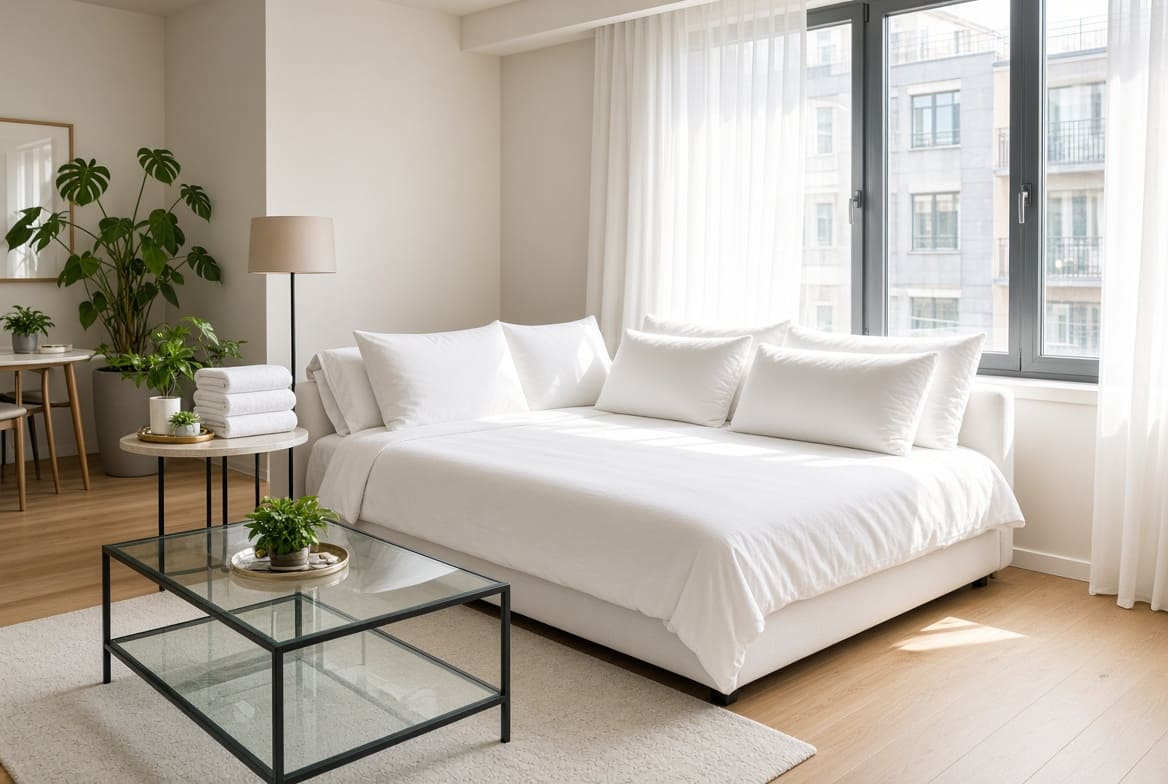
- A turnover is a reset, not a tidy-up. The room has to match your listing photos, not just look clean.
- Bathrooms and beds generate most cleanliness complaints, so they get cleaned first, while you still have energy and daylight.
- Los Angeles tap water runs 7 to 16 grains per gallon, which means shower glass, faucets and glassware need an acidic descaler, not all-purpose spray.
- Keep 3 linen sets per bed. Laundry is the single biggest reason turnovers run past the check-in time.
- Photos of every finished room take 3 minutes and settle almost every dispute about damage or cleanliness.
- The 11 am to 3 pm window in LA is closer to 3 hours once parking, traffic and laundry are counted honestly.
Guests forgive a lot. A slow shower drain, a stiff sofa, a neighbour’s dog. What they do not forgive is a hair on the pillowcase or a ring inside the toilet bowl, because those two things tell them the exact same story: nobody checked. That story ends up in your cleanliness rating, and cleanliness is the one score that follows you into search results.
We clean short-term rentals across Burbank, Glendale, Studio City, Sherman Oaks, Pasadena, Encino, Beverly Hills and Calabasas, and the routine below is the one our crews actually use. It is written in the order the work happens, because order is what saves time.
Turnover cleaning is a different job from house cleaning
A weekly house clean maintains a home somebody already lives in. A turnover erases one stay completely and stages the property for a stranger who booked from photos. The tasks overlap maybe 60 percent. The mindset barely overlaps at all.
The guest arrives with a review form already open
The first 90 seconds after the door opens decide the review. Guests do a lap: they look at the bed, they open the bathroom, they check the kitchen counter. Nobody inspects baseboards on arrival. They inspect the things they are about to touch with a bare hand or a bare foot.
So the routine has to be weighted. Spend disproportionate time on the shower glass, the toilet, the bedding, the kitchen sink and the floors, and the rest of the property carries itself.
Cleanliness ratings behave differently from your other scores
Location and value scores drift slowly. Cleanliness swings hard on single incidents, because a guest who finds one thing goes looking for a second. Once they start hunting, they find crumbs in a drawer, dust on a lampshade, a used soap bar in the shower caddy, and the review turns into a list.
The defence is consistency rather than intensity. The same sequence, every turnover, even on a Sunday with 2 checkouts and a wedding on Ventura Boulevard blocking your route.
Set the property up so the clean can actually be fast
Most turnovers run long for reasons that have nothing to do with cleaning speed. The cleaner drives to a store for trash bags. The vacuum is dead. There are 2 sets of sheets and one is still damp. Fix the setup once and every future turnover gets shorter.
Build a supply closet the cleaner never has to leave
Lock a closet or a cabinet and stock it so the whole job can be done without stepping outside. Ours works out to roughly this list per property: all-purpose cleaner, a bathroom acid descaler, glass cleaner, stainless polish, disinfectant with a stated dwell time, 12 or more microfiber cloths in 3 colours, 2 sponges, a toilet brush per bathroom, a vacuum with a working HEPA filter, a flat mop with washable pads, trash bags in 2 sizes, and a full backup of every consumable.
Colour-coded cloths matter more than people expect. Blue for glass and mirrors, yellow for general surfaces, red for toilets and nothing else. It costs nothing and it ends cross-contamination arguments permanently.
Keep 3 linen sets per bed
One set on the bed, one clean in the closet, one in the wash. With 2 sets you are always waiting on a dryer, and waiting on a dryer is how a 3 pm check-in becomes a 4:40 pm apology.
Buy white. Every set matches every other set, bleach becomes an option, and stains get diagnosed instead of hidden. Retire anything grey or pilled rather than flipping it to the guest bedroom, since guests photograph bedding and post it.
Your reference photos are the real checklist
Take a photo of every room in its perfect staged state and keep it in a shared album. Cleaners stage to the photo instead of guessing which way the throw blanket folds or how many pillows belong on the sofa.
This solves a problem written checklists never solve. A list can say «arrange decorative pillows.» Only an image says how.
The room-by-room turnover checklist
Work top to bottom, dry to wet, back of the property to the door. Floors last, always. Below is the sequence with realistic timing for a 2-bedroom unit, roughly 2.5 hours for one cleaner and about 90 minutes for a team of 2.
First 10 minutes: laundry, trash, triage
Walk in and start the washing machine before touching anything else. Strip every bed completely, including mattress protectors if they look used, collect every towel including the ones folded neatly on the rack, and load.
Then a fast lap with a trash bag. Empty every bin, clear the fridge of guest food, collect bottles and takeout containers, and note anything broken or missing on your phone as you go. This lap also tells you whether this is a normal turnover or a 4-hour one.
Bathrooms
Spray the toilet interior and the shower with acid descaler and let it sit while you work the rest of the room. Dwell time is doing the labour that scrubbing would otherwise cost you.
Then: mirror, counter, sink, faucet polished dry, toilet exterior including the base and the bolts behind the seat, shower walls, shower glass, drain and drain cover, fixtures. Hair is the item guests report most, so check the drain cover, the corner behind the toilet, and the inside rim of the sink bowl specifically.
Finish with fresh towels folded identically in every bathroom, a new bath mat, at least 2 rolls of toilet paper with one visible, soap topped up, and the toilet brush itself rinsed and dried. A dirty brush in a clean bathroom reads as worse than no brush.
Kitchen
Guests judge kitchens by touch. Sticky is fatal. Wipe cabinet fronts and handles, not just counters, since that is where cooking grease lands.
Run through: dishwasher emptied and its filter checked, sink scrubbed and the faucet dried to a shine, counters and backsplash, microwave inside and out, stovetop including grates and knobs, oven door glass, refrigerator interior shelves and the rubber door gasket, coffee maker emptied with a fresh filter, toaster crumb tray, and the inside of the trash can rather than just a new liner.
Open 2 or 3 cabinets at random. Guests do this looking for a mug and find last week’s crumbs.
Bedrooms
Make beds with a hotel finish: fitted sheet tight, flat sheet or duvet squared, pillows plumped and standing, no wrinkles across the top third of the bed because that is the part that photographs.
Check under the bed, between mattress and headboard, and inside every drawer and nightstand. Personal items left behind are common and awkward. Dust the headboard, lamps, ceiling fan blades and window sills, then vacuum, including along the baseboards where dust collects in a line.
Living areas, entry and outdoor space
Vacuum under the sofa cushions and lift them out. Wipe remotes, light switches, door handles, thermostat and railings with disinfectant, then dry them so they are not left tacky. Clean the TV screen with a dry microfiber, never with glass spray.
Outside, sweep the balcony or patio, wipe the furniture, empty the ashtray if you allow one, clear leaves from the entry, and check the pool deck and grill if you have them. In hillside properties around Calabasas and the Hollywood Hills, outdoor surfaces collect more debris in a week than an indoor floor does in a month.
Expert note. We time our crews on 3 things: laundry start, bathroom finish and door photos. If laundry starts within 4 minutes of arrival and bathrooms are finished before the halfway mark, the turnover lands on schedule about 9 times out of 10, regardless of how messy the checkout was. When bathrooms slip to the second half, the whole job runs 30 to 45 minutes over. The sequence protects the schedule far more than working faster does.
What Los Angeles adds to the routine
The checklist is universal. The conditions here are not, and hosts who use a generic national checklist keep losing points on things a local crew treats as routine.
Hard water leaves a signature on everything
LA water runs roughly 7 to 16 grains per gallon depending on your neighbourhood’s source blend, and Pasadena, Glendale and parts of the San Gabriel Valley sit at the harder end. All-purpose cleaner will not remove mineral scale. It smears it.
Use an acidic descaler on shower glass, faucets, showerheads and the inside of kettles, and dry every metal fixture with a separate cloth afterward. Wet glass air-drying is how you rebuild the film you just removed. Glassware that comes out of the dishwasher cloudy needs a rinse aid rather than a rewash, and cloudy glasses in a cupboard get photographed.
Dust, ash and Santa Ana weather
During Santa Ana wind events a property that was spotless on Monday has visible dust on dark furniture by Wednesday. If a listing sits vacant for several days, the property needs a touch-up dust and a floor pass before arrival even though nobody stayed in it.
After any regional smoke event, add HVAC filter checks and a wipe of window sills and door tracks to the turnover. Guests notice smoke smell instantly and describe it in reviews with a precision they never apply to anything else.
The checkout window is shorter than the calendar says
An 11 am checkout and a 3 pm check-in reads as 4 hours. Subtract parking in Studio City or West Hollywood, a guest who leaves at 11:25, one dryer cycle, and the drive if your cleaner has an earlier job in Burbank. The real working window is often closer to 3 hours.
Build the schedule against the real number. If your property regularly gets same-day bookings, either block a buffer night on turnover-heavy weekends or use a crew of 2 so the laundry and the bathrooms run in parallel.
The final walkthrough and the photo record
The walkthrough is a separate step with a separate mindset. Stop cleaning, walk in as if you were the guest, and look at the property from the doorway of each room.
Six checks at the door
Smell first: the property should read as neutral and clean, not perfumed. Heavy fragrance triggers complaints from guests with sensitivities and reads as a cover-up. Then test every light switch and replace dead bulbs. Set the thermostat to a comfortable arrival temperature, around 72 degrees. Confirm the TV powers on and the WiFi connects. Verify all windows and doors lock and the smart lock code works. Last, a supply scan across bathroom, kitchen and laundry.
Also check floors on bare feet. Sticky spots and grit show up through socks long before they show up to the eye.
Photograph the finish, every single time
Shoot every room from the same angle each turnover, plus the bathroom counter, the made bed, the kitchen counter and any pre-existing damage. It takes about 3 minutes.
Those photos do 3 jobs. They prove the property was guest-ready if someone complains at 9 pm. They give the next cleaner a staging reference. And they establish a timeline if a damage claim comes up later. Hosts managing properties remotely tell us this is the part they value most, since it lets them confirm readiness from a phone without driving across town.
Report damage before it becomes your problem
Anything broken, stained, missing or leaking gets photographed and sent to the host the same day, with a timestamp. Not at the end of the week.
Split reports into 2 buckets. Normal wear covers scuffs, a loose cabinet hinge, a worn towel. Damage covers burns, deep stains, cracked glass, missing items and anything a guest caused. The second bucket is time-sensitive under platform claim rules, and a report filed after the next guest has already checked in is very hard to substantiate.
Deep cleans, and when to hand the turnover over
A turnover clean and a deep clean are not the same product, and mixing them up is why some hosts feel their property slowly declines despite paying for cleaning every week.
What a turnover clean cannot fix
Turnovers do not cover oven interiors, grout, inside window tracks, curtain laundering, upholstery extraction, refrigerator coils, baseboards under furniture or mattress protectors that need a hot wash. Those tasks accumulate quietly.
Schedule a deep clean every 2 to 3 months for a busy listing, after any stay longer than 30 days, and before your high season. Carpet and upholstery treatment on its own schedule, usually 1 to 2 times a year depending on traffic and whether you allow pets.
What a professional turnover should include
If you are hiring rather than cleaning yourself, the service is worth its fee when it includes calendar-synced scheduling, a property-specific checklist rather than a generic one, restocking from your own supply closet, on-site laundry or a linen swap, photo verification before lockup, damage reporting the same day, and insurance that covers your property.
Two-bedroom turnovers in the LA area typically run in the $150 to $300 range depending on size, laundry volume, outdoor areas and how tight the same-day window is. Cleaning yourself makes sense if you live nearby, host occasionally and have a flexible schedule. It stops making sense the first weekend you have back-to-back bookings, a stuck dryer and a guest arriving at 3.
If you host in Burbank, Glendale, Pasadena, Sherman Oaks, Encino, Studio City, Beverly Hills or the surrounding cities and want a turnover crew that works from your reference photos and sends proof before locking up, we are reachable by call, text or WhatsApp at +1 747 241-2921.
Short-Term Rental Turnover FAQ
How much should I set my cleaning fee at on an LA listing?
Start from your real cost per turnover, which includes cleaner labour, laundry, supplies and consumables, then add a small buffer. Most hosts land somewhere between 25 and 50 percent of their average nightly rate. Since platforms now display total price upfront, an unusually high fee shows up in search comparisons and suppresses bookings, so many LA hosts absorb part of it into the nightly rate instead.
Should I ask guests to do chores before checkout?
Light requests work: strip the beds, start the dishwasher, take trash to the bin. Keep it to 3 items maximum and put it in your house rules before booking, not in a note taped to the door. Longer lists read as a second cleaning fee and reliably cost you a star.
Do I need to be present while the cleaners work?
No, and most hosts we work with are not. What the crew needs is entry access, a stocked supply closet and a contact who answers messages during the window. Photo verification replaces supervision.
Can one cleaner handle a same-day turnover on a 3-bedroom?
Sometimes, but it is tight. With multiple bathrooms and 3 or more beds of laundry, a solo cleaner needs closer to 4 hours, which does not fit an 11 to 3 window once travel is counted. A team of 2 is the safer arrangement for anything above 2 bedrooms on back-to-back bookings.
A guest messaged about cleanliness after check-in. What now?
Respond within minutes, apologise without arguing, and offer a specific remedy such as sending someone back that evening. Then pull the turnover photos. Most complaints are resolved by a targeted return visit, and a fast fix often prevents the issue from appearing in the public review at all.
Are eco-friendly products strong enough for short-term rental turnovers?
Yes, provided you match the product to the surface and respect dwell times. Plant-based degreasers and citric acid descalers handle LA kitchens and mineral scale well. Where disinfection matters, look for a registered disinfectant and follow its contact time rather than wiping immediately.
Should the cleaner supply linens or should I?
Owning 3 sets per bed and having the crew launder on site is the cheaper option for single properties and gives you control over quality. A linen delivery service costs more per turnover but removes laundry from the schedule entirely, which is worth it once you are running several properties or facing repeated same-day turnovers.