

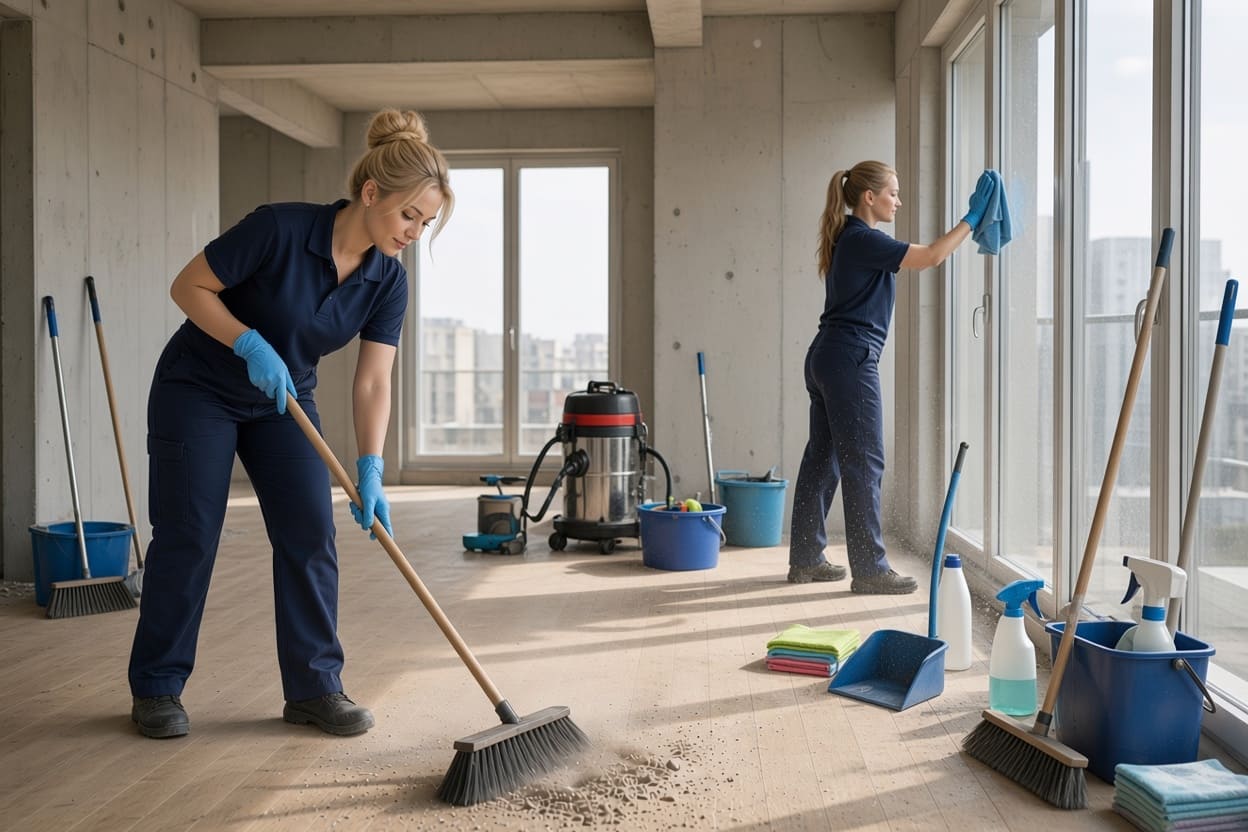
- Post-construction cleaning splits into 3 passes — rough, light and final — because dust keeps falling out of the air, cabinets and ductwork for days after the last tool leaves.
- Each phase is tied to a trade, not to a calendar date. Book the rough clean before flooring goes down, the light clean after paint and fixtures, the final clean after the punch list closes.
- Dry sweeping construction dust is banned on California job sites. Wet methods and HEPA vacuums are the standard, and any crew that shows up with a push broom is a problem.
- More new finishes get ruined during cleaning than during construction. Razor blades on tempered glass, acidic cleaners on marble and ammonia on brushed nickel cause damage that no one can undo.
- Around Los Angeles, interior post-construction cleaning runs roughly $0.15 to $0.60 per square foot, with local averages landing near $0.35. Phased projects are quoted per visit.
- A 10-minute inspection with a flashlight and a white cloth catches almost everything a crew missed, and it needs to happen before you release the final payment.
Why Post-Construction Cleaning Happens in 3 Passes, Not 1
Homeowners in Burbank, Glendale and Sherman Oaks call us every week with the same question: the contractor already swept, so why does the house need three separate cleanings? The honest answer is that sweeping moves dust sideways. It does not remove it.
Fine construction dust behaves like smoke. Particles under 10 microns stay airborne for hours, drift through open doors, and settle again long after a crew packs up. If you clean once and clean early, you are cleaning surfaces that will be dusty again by the time the flooring installer finishes. That is why the trade splits the work into rough, light and final — each pass targets a different kind of mess at a different point in the build.
What Construction Dust Actually Is
It is not one substance. Drywall compound, silica from concrete and tile cutting, sawdust, joint tape fibers, paint overspray, adhesive residue, grout haze and metal filings all behave differently and respond to different tools.
Silica is the one worth taking seriously. It comes from cutting concrete, stone countertops, stucco and tile, and it is fine enough to reach deep lung tissue. California has confirmed more than 230 silicosis cases since 2019, mostly among stone fabrication workers. You are not fabricating countertops in your living room, but the residue lands there, and how it gets picked up matters.
Drywall dust is the opposite problem. It is alkaline, it dissolves and smears when you hit it with a damp cloth too early, and it turns into a chalky film on windows that people mistake for permanent haze.
The Cost of Compressing 3 Phases Into 1
We get called in behind other companies often enough to know what a rushed single clean looks like 2 weeks later. Dust reappears on baseboards. Cabinet interiors smell like sawdust. The HVAC system, which was never addressed, redistributes everything it collected during framing every time the thermostat clicks on.
Then there is the finish damage. Paint splatter and adhesive harden with time. Grout haze that would have wiped off with a damp sponge on day 2 needs an acidic remover on day 30, and acidic removers are exactly what you cannot use on marble or limestone.
Phase 1 — The Rough Clean Checklist
The rough clean is not detail work. It is a volume job that makes the site safe, walkable and ready for the trades who still have to come back. Nobody sees this phase in the finished photos, but skipping it slows every subcontractor who follows.
When to Schedule It
Book the rough clean once framing, drywall, plumbing rough-in, electrical rough-in and HVAC installation are substantially done, and before flooring, final paint and delicate finishes go in. On a full remodel, that usually means the moment the drywall crew leaves.
On a phased kitchen or bath project where the family is still living in the house, we often run a compressed rough clean at the end of each week to keep dust from migrating into bedrooms.
Room-by-Room Rough Clean Tasks
- Haul out lumber offcuts, drywall scraps, packaging, empty buckets, banding and pallets
- Sweep up and magnet-pick nails, screws and staples from floors, thresholds and exterior walkways
- Scrape drywall mud, joint compound and thinset off subfloors before it cures hard
- HEPA-vacuum subfloors, window sills, framing ledges and stair stringers
- Wipe down electrical boxes, junction plates and rough-in openings so finish trades are not working in grit
- Clear window tracks and door thresholds of gravel and stucco chips
- Sweep and rinse driveways, walkways and side yards where materials were staged
- Bag and remove trash from the site rather than leaving it in the client’s bins
Safety Rules That Apply on Every California Site
Cal/OSHA prohibits dry sweeping and compressed air blow-off where silica exposure is possible, and requires wet methods or HEPA-filtered vacuums for cleanup of silica-bearing waste. This is not paperwork. Inspectors can stop work on the spot for dry sweeping.
There is a second issue specific to Los Angeles housing stock. A large share of homes in Highland Park, West Adams, Pasadena and the older Valley neighborhoods were built before 1978, which means lead-based paint is a live possibility in any project touching original trim, windows or plaster. Lead-safe work practices call for containment, wet cleanup, HEPA vacuuming and disposable protective clothing. If your contractor did a renovation, repair and painting job under those rules, the cleaning crew has to work inside the same discipline.
Phase 2 — The Light Clean Checklist
The light clean, sometimes called the detail or intermediate clean, is where the space stops looking like a job site. Surfaces get scrubbed rather than swept, and the crew starts working from the ceiling down for the first time.
This is also the phase most likely to be rushed by a general contractor trying to hit a handover date. It should not be. Everything the final clean has to do gets easier or harder based on how thorough this pass was.
Timing Around Trades
Run the light clean after paint is dry, cabinets are hung, fixtures are set and flooring is installed, but before punch-list touch-ups. Painters, tile setters and electricians will come back, and they will leave marks. That is expected and normal.
Wait 24 to 48 hours after the last dust-generating task before starting. Airborne particles need that window to fall. Starting sooner means cleaning the same horizontal surfaces twice in one visit.
Surfaces That Need Detailing First
- Ceilings, ceiling fans, recessed light trims and pendant fixtures
- Walls wiped top to bottom with dry or barely damp microfiber, never soaked
- Crown molding, door casings, window casings and baseboards, including the top edge nobody checks
- Inside every cabinet, drawer, closet, pantry and vanity, then the exteriors
- Window frames, sashes, sills and the tracks where grit collects
- Vent covers and register grilles removed, washed and reinstalled
- Switch plates, outlet covers, door hardware, hinges and stops
- Adhesive labels off appliances, glass, plumbing fixtures and hardware while the glue is still soft
- Floors vacuumed with HEPA, then damp-mopped with a cleaner matched to the material
Materials That Get Damaged at This Stage
Natural stone is the usual casualty. Marble, limestone and travertine etch on contact with anything acidic, so vinegar, lemon-based cleaners and standard grout haze removers are off the table. Use a pH-neutral stone cleaner and nothing else.
Unlacquered brass and living-finish faucets react to abrasives and to ammonia. Brushed nickel and matte black fixtures scratch under scouring pads. New luxury vinyl plank looks bulletproof and is not — steam mops void most manufacturer warranties on the market.
From our crew lead in Burbank: The single most expensive mistake we get called to look at is razor-scraped glass. Someone attacks paint specks on a new window with a blade, and the glass comes away with hairline scratches running in the direction of the stroke. Tempered glass carries microscopic fabricating debris fused to the surface from the heat treatment, and a dry blade drags that debris across the pane. Once it is scratched, the fix is replacement, and on a large fixed pane in a Calabasas or Brentwood build that is a 4-figure invoice. The working method is different: soak the spot with a soapy solution, let it sit, lift the softened material with a plastic scraper held nearly flat, and keep the surface wet the entire time. Test a bottom corner first. On low-E coated glass and on anything with aftermarket film, no blade touches it at all.
Phase 3 — The Final Clean Checklist
The final clean happens after the punch list closes and before anyone moves in or a listing photographer arrives. It is a presentation pass. The building is already clean; this is about consistency, polish and air quality.
Crews plan roughly 1 hour per 100 to 200 square feet at this stage, which puts a 2,500 square foot home somewhere between 8 and 12 hours with a team of 3.
Room-by-Room Final Detail
- Kitchen: appliance interiors and exteriors, oven racks, refrigerator seals, range hood filters, backsplash, sink and disposal flange, cabinet faces and toe kicks
- Bathrooms: toilets top to floor bolts, shower glass, tub surrounds, grout lines, mirrors, chrome, exhaust fan covers, vanity interiors
- Bedrooms and living areas: closet shelving, mirrored doors, window treatments if installed, floor edges and corners
- Laundry: behind and under the machines, dryer vent connection, utility sink
- Stairs: treads, risers, handrails, balusters and the dust shelf on each stringer
- Entry and exterior: front door glass, threshold, porch, garage floor, patio, and driveway pressure wash where needed
- Fingerprints removed from every glass and metal surface as the last action in each room
Glass, Stone and Metal Without Scratches
Los Angeles tap water runs hard through most of the basin, and it leaves visible mineral spotting on new glass and polished stone if it dries on the surface. Squeegee immediately, dry with a waffle-weave cloth, and on large window walls work in shade rather than direct sun. Panes that dry too fast streak no matter how good your solution is.
Stainless steel takes its polish in the direction of the grain. Wiping across it leaves a haze you will see from every angle in the room.
Air, HVAC and the Part Everyone Skips
Keep the HVAC system off during heavy dusting so it does not inhale everything you disturb. Once cleaning is finished, vacuum inside the accessible portion of each register and supply boot, wipe the grilles, and install fresh filters.
Plan on a second filter change about 30 days after occupancy. Residual dust keeps working its way out of wall cavities and ductwork for weeks, and that second change is what stops the reappearing-dust complaint before it starts.
Homes going up under California’s updated Wildland-Urban Interface rules, which took effect on January 1 of this year, use ember-resistant vents with much finer mesh than older builds. In the Palisades and Altadena rebuilds we have worked on, those screens clog with construction dust fast. They need a soft brush and a vacuum, not a hose.
How to Verify the Work Before You Sign Off
A walkthrough where everyone nods and says it looks great is not an inspection. Bring a flashlight and 10 minutes of patience, and check the places dust hides rather than the places it shows.
5 Tests That Take 10 Minutes
- Raking light. Hold a flashlight almost flat against walls, glass and floors. Film, streaks and scratches appear instantly at that angle and are invisible head-on.
- The ledge test. Run a white cloth along the top edge of door casings, upper cabinets and the highest shelf in every closet.
- Track and corner check. Open every window and slider. Look at the tracks, the weep holes and the corners where the frame meets the sill.
- Cabinet interiors. Open all of them, including the ones with nothing in them yet. Sawdust in a drawer bottom is the clearest sign of a rushed pass.
- Register pull. Take one vent cover off. What you find there tells you whether the HVAC was addressed or ignored.
What to Put in the Contract
Write down which phases are included and which are separate visits. Write down whether debris hauling and disposal fees are inside the price. Write down who supplies water and power, because a site without either changes the job substantially.
Agree in advance on a punch-list window. A reasonable crew will come back within a few days to correct anything the walkthrough turns up, and stating that in writing beats arguing about it later.
What Post-Construction Cleaning Costs Around Los Angeles
Pricing varies more in this market than almost anywhere, because a 900 square foot Silver Lake condo with one gutted bathroom has nothing in common with a 4,500 square foot Hidden Hills rebuild.
Pricing Models and Realistic Ranges
Interior post-construction cleaning generally runs $0.15 to $0.60 per square foot nationally, and Los Angeles averages sit near $0.35 per square foot. Rough cleans price at the lower end of that band, final cleans at the upper end. Small jobs are usually billed hourly instead, and most companies here carry a minimum charge.
Labor is roughly 90% of the invoice. Debris disposal typically adds $100 to $300 when it is not folded into the contractor’s dumpster.
Local Conditions That Change the Number
Access drives cost more than most people expect. A hillside property in Studio City with 40 stairs from the street, a Century City high-rise with a freight elevator reservation window, or a Westlake Village HOA that limits work hours all add labor time.
Stucco and exterior stonework are common on properties across Pasadena, Encino and Calabasas, and they generate a heavier, grittier dust load than an interior-only remodel. Uncovered windows during construction, no on-site water, and a compressed timeline that requires a larger crew all push the quote up too.
If you want a number you can actually budget against, get a walkthrough. Square footage alone does not describe the site, and any estimate given without seeing the space is a guess. We are reachable at +1 747-241-2921 for a look at the project and a straight answer on scope.
Post-Construction Cleaning FAQ
Can I handle post-construction cleaning myself?
For a single small room, yes, provided you have a HEPA shop vacuum, a respirator rated for fine particulate, eye protection and a plan for disposal. For a whole-home build, the limiting factor is usually equipment rather than effort. A household vacuum without HEPA filtration exhausts fine dust back into the room, which is why DIY cleanups so often end with dust settling again the next morning.
Who pays for it, the contractor or the homeowner?
It depends entirely on the construction contract. Many general contractors include debris removal and broom-clean condition, which is not the same as a finish clean. Read the scope of work before the build starts and ask directly whether a detail clean is included. On commercial projects the responsibility may sit with the developer, the tenant or the property manager.
Why does dust reappear a few weeks after the clean?
Almost always the HVAC system or wall cavities. Dust that settled in ductwork during framing keeps circulating until filters are changed and registers are vacuumed. Recessed lighting cans and unsealed attic penetrations are the second common source.
Does the price include hauling debris away?
Not automatically. Light debris removal is usually included, but bulk hauling, dumpster rental and landfill fees are typically quoted separately. Ask specifically, because disposal costs in Los Angeles County are not trivial.
How far ahead should I book a crew?
2 to 3 weeks of lead time is comfortable, more during spring and summer when remodel completions cluster. Build in flexibility, since punch lists slip constantly and a firm cleaning date that arrives before the work is finished helps nobody.
Can you clean while we are still living in the house?
Yes, and it is common on phased kitchen and bathroom remodels. The approach changes: containment barriers, cleaning at the end of each work stage rather than at the end of the project, and extra attention to the pathways between the work zone and the rest of the home.
Is this different for a rental or short-term listing turnover?
The cleaning itself is the same, but the deadline is not. Listings go live on a fixed date and photographers arrive before guests do, so the final clean has to be scheduled around the photo shoot rather than the move-in. We usually recommend a light touch-up between the shoot and the first booking.