



A wrinkled shirt on camera costs more than it seems. Someone spots it on the monitor when the lights are set, the model is in makeup and the whole set is waiting while somebody hunts for a steamer and an outlet. This is for stylists, photographers, commercial producers and wedding planners in Los Angeles. It covers fabrics, water, power, setting up a station and where our service fits and where it doesn’t.
Where on-site steaming saves time
Steaming itself is simple work. What eats the time is doing it in bits, between other tasks and at the last minute.
Brand photo and video shoots
On a lookbook or catalog shoot, dozens of pieces go through someone’s hands in a day. If the stylist’s assistant is steaming, tagging looks and running to set at the same time, some of it gets done badly. A dedicated person on steaming keeps finished looks on the rack in shooting order, and the stylist works on the shot instead of the iron.
Weddings and events
The Knot recommends steaming the wedding dress the night before. A simple dress takes 30-45 minutes, a full gown with a train one to two hours, and then it needs to hang for 20-30 minutes so the fabric settles. The groom’s and groomsmen’s suits and the bridesmaids’ dresses are steamed on the morning of the wedding, and tablecloths and drapes at the venue once they’re hung.
Film and TV sets
In Los Angeles, wardrobe on union film and TV productions is handled by costumers from IATSE Local 705, Motion Picture Costumers. An outside contractor on that kind of set coordinates the work with the costume department, not directly with the producer. Our service is built for stylists, brands, photo studios, non-union commercial shoots, weddings and private events.
Which fabrics you can steam and which you can’t
Steam smooths out almost everything, but it ruins some fabrics for good. Before the job, put together a list of pieces with fiber content from the labels. It saves the first hour on set.
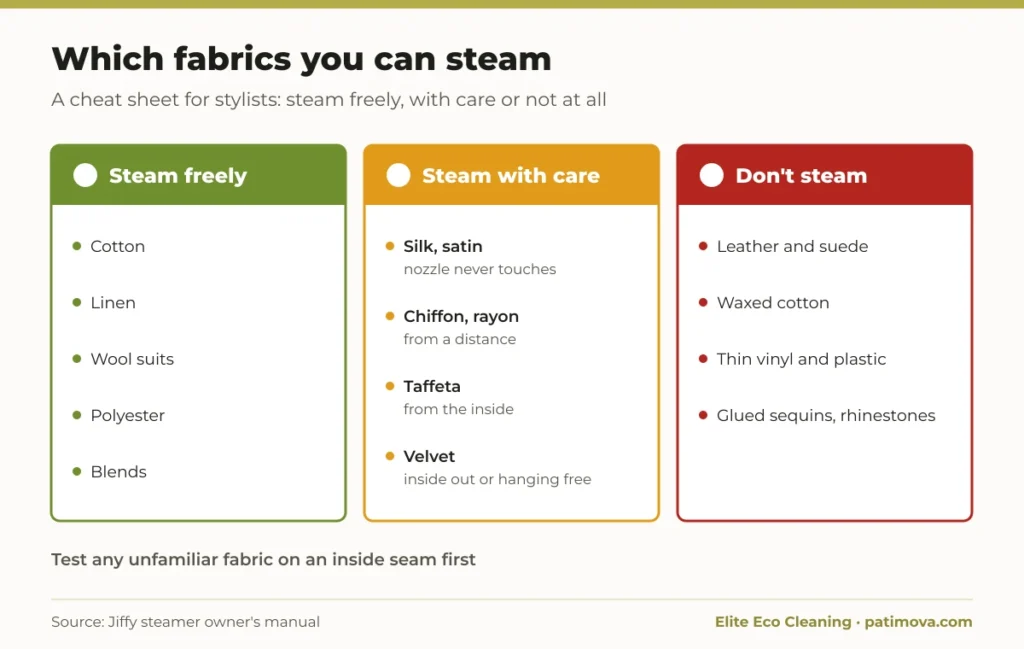
Steam freely
Cotton, linen, wool suits, polyester and blends. Wool is steamed in slow passes so the steam goes through the fabric. Linen gets softer after steaming but won’t hold a sharp crease. If trousers need a sharp crease, that’s a job for an iron.
Steam with care
Silk, satin, chiffon and rayon are steamed from a distance without touching the nozzle to the fabric. A drop of condensation on silk leaves a spot that shows on camera. Taffeta is steamed from the inside. Velvet and other pile fabrics are steamed from the inside or hanging free, without pressing the nozzle, or the pile gets crushed, and the Jiffy manual calls this out specifically. Any unfamiliar fabric gets tested on an inside seam first.
Don’t steam
Leather, suede, waxed cotton and anything that can melt, like thin vinyl and plastic trim. Sequins, rhinestones and beads that are glued on come loose under hot steam, so those pieces are steamed from the inside away from the decoration or not at all.
Water and equipment
A good steamer on bad water does worse than an average one on distilled.
Why you need distilled water
According to Burbank Water and Power’s 2024 report, Burbank’s average water hardness is 285 mg/L, or 16.6 grains per gallon, while the U.S. Geological Survey calls water hard starting at 121 mg/L. Minerals build up in the boiler and come out with the steam as white flecks, which show on camera on dark and sheer fabric. Jiffy recommends descaling every 3-6 months depending on the water. That’s why crews bring distilled water to the job.
Why a steamer spits water
Spitting hot water usually isn’t a malfunction. Steam cools in the hose, condensation collects in a sagging loop and shoots out with the next burst. The hose should hang straight up so water drains back into the tank, which is exactly what the Jiffy manual says.
Which steamers to bring on set
The Jiffy J-2000 floor model has long been a staple in costume departments and showrooms. It has a 1300-watt heating element, heats up in two minutes and gives an hour and a half of steam on one fill. Handheld travel steamers are fine for a couple of pieces, but they can’t keep up with a shoot day with dozens of looks.
Power on set
It’s the question people remember last, and it’s the first one to stop the work.
One circuit, one steamer
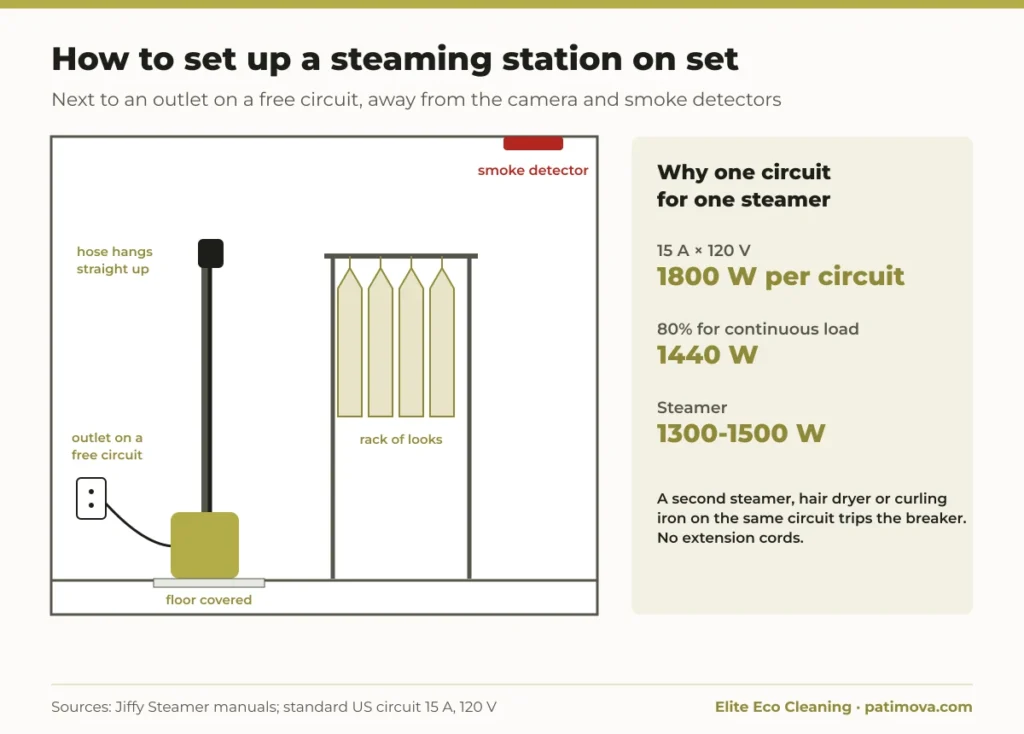
A standard 15-amp, 120-volt household circuit handles 1800 watts, and for continuous loads electricians count 80% of that, or 1440 watts. A 1300-1500 watt steamer takes up the whole circuit. A second steamer, a hair dryer or the makeup artist’s curling iron on the same circuit will trip the breaker. On location, ask the owner or an electrician which outlets are on separate circuits, and at a studio the lighting department handles it.
No extension cords
The Jiffy manual states plainly that the steamer should not be used with an extension cord. A thin extension cord heats up under that load. So the station goes next to an outlet on a free circuit, not wherever the stylist would like it.
Steam and smoke detectors
Steam from a garment steamer can set off some smoke detectors the same way smoke does. In hotels and rented venues, a fire alarm stops the shoot and can end in a fine. Set the station away from detectors, and at studios agree on the spot with whoever is in charge of fire safety.
How to set up a steaming station
The station takes up 20-30 square feet. What matters more is where it stands and in what order the pieces move through it.
Location
Away from the camera, lights and detectors, next to an outlet on a free circuit and next to the wardrobe racks. Put something down on the floor under the steamer, nobody wants drips on the hardwood in someone else’s house. If the makeup room is close by, keep the steam away from the makeup artists, because humid air makes powder harder to work with.
Working with the stylist
Pieces are tagged by look and by model. They’re steamed in shooting order, not in the order they hang on the rack. A finished look goes on a separate rack and stays untouched until the fitting. Keep the steamer on between takes, because fixing a crease on the back of a jacket should take a minute, not five.
How long each piece takes
A cotton shirt takes a few minutes, a wool suit longer, a wedding gown with a train up to two hours. Plan the time by looks and fabrics, not by the number of pieces, and the shoot day won’t fall apart.
Elite Eco Cleaning team comment
For steaming jobs we bring our own floor steamers and garment racks. Before the job we ask for a list of looks with fabric content and a floor plan with outlets, if there is one. We don’t remove stains, do alterations or send things to the dry cleaner. Our job is to make sure the clothes are smooth, hanging in the right order and ready for the shot.
How much on-site steaming costs
Studios that steam clothes in-house usually charge per piece. For on-site work it makes more sense to charge by the hour, since the time depends on the fabric, not the number of pieces.
Price
$60 an hour, 3-hour minimum, which comes to $180. For a wedding, three hours covers a gown with a train and several suits. For a full-day shoot, book a shift that matches the length of the shoot day, with extra time for touch-ups between takes.
What’s included and what isn’t
Included: steaming suits, dresses, shirts, wedding attire, delicate fabrics, curtains and drapes, plus hanging and packing. Not included: stain removal, dry cleaning, alterations, ironing and smoke odor treatment.
FAQ:
Can you steam curtains while they’re still on the rod?
Yes, curtains and drapes are steamed in place, no need to take them down. Heavy blackout curtains on a high rod can be steamed from the floor up to wherever the nozzle reaches.
Can you steam the bride’s dress on the morning of the wedding?
We work from 8 am to 10 pm. If getting ready starts earlier, it’s easier to steam the dress the night before, as The Knot recommends. The dress will relax overnight, and in the morning all that’s left is touching up the veil and the suits.
Can I book steaming at a hotel after a flight?
Yes, we come to your room. Let the hotel know a steamer will be running and ask where the smoke detectors are in the room so we can set up away from them.
Do you need an ironing board or a table?
No, pieces are steamed on hangers, and we bring the racks. We need a free outlet on its own circuit and a spot by the wall about 6 by 6 feet.
Do you pack the clothes after steaming?
Yes, hanging and packing are part of the service. To transport finished looks, have garment bags ready, and we’ll hang the pieces in them by look.
Добавить комментарий