

When a forest burns, what’s left is mostly wood ash. When neighborhoods burn, everything houses and cars are made of goes up into the air. Old lead paint, insulation, plastic, roofing materials, household chemicals from garages. All of it settles on window sills, carpets and toys in homes the fire never touched.
The California Department of Public Health specifically warns that wet ash can cause chemical burns on skin. If it gets on your hands or face, wash it off right away, don’t wait until you finish cleaning.
What testing after the Eaton and Palisades fires showed
In 2025, Los Angeles County tested soil on lots where homes survived. Downwind of the Eaton fire, 10 of 23 lots had lead levels above the 80 mg/kg threshold. In the Palisades area, only a few samples exceeded limits for cadmium, arsenic and polycyclic aromatic hydrocarbons.
Caltech researchers found lead in household dust more than 7 miles from the fire perimeter. Ash that the wind carried into a home in Pasadena or La Cañada Flintridge can’t be considered safe just because the fire was far away.
The county recommends testing for everyone who lives within 250 yards of a burned structure. You can get a free blood lead test by calling 1-800-LA-4-LEAD.
Who should stay out of the cleanup
South Coast AQMD lists the groups who need to keep away from ash. That means children, pregnant women, older adults and anyone with heart or lung disease, asthma included.
Don’t ask kids to help, and don’t bring them home until the ash is gone. Dogs and cats are better off with friends while the work is going on, and after a walk in the yard wipe their paws and fur with a damp cloth. Take shoes off at the door, otherwise ash from outside spreads through the rooms all over again.
Photos for the insurer first, cleaning second
Rushing this step costs more than anything else. A freshly cleaned house looks great to the people living in it and bad for the insurance adjuster, because the smoke residue is no longer visible.
In March 2025 the California Department of Insurance issued Bulletin 2025-7. An insurer can’t deny a smoke damage claim without a proper inspection and has to pay for lab testing when it’s needed. Additional Living Expenses coverage, or ALE, applies even when the house itself wasn’t damaged by fire. In September AB 1795 was signed into law. It takes effect January 1, 2027 and makes insurers responsible for paying for testing in fire areas. The Department of Insurance hotline is 1-800-927-4357.
What to photograph and record on video before cleaning starts
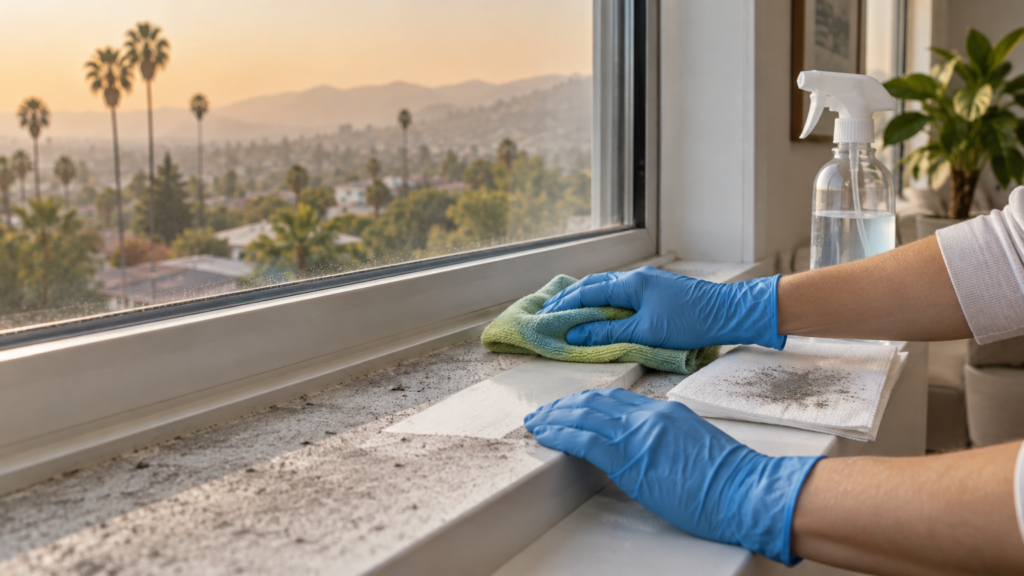
Walk through the house with your phone and take a wide shot of every room. Then close-ups of window sills, the tops of cabinets, vent grilles, the AC filter and light-colored fabrics. Residue shows up well if you wipe a surface with a white paper towel and photograph the towel next to the spot you wiped.
Shoot the items you’ll have to throw away separately. Don’t toss anything before the adjuster’s visit, put it in heavy-duty bags and label them.
When air and dust testing comes before cleaning
In some situations an industrial hygienist goes in first, and cleaning follows their report. The house is within 250 yards of a burned building. The house was built before 1978 and has peeling paint inside. A persistent smell of smoke is still there several days after the fire. The walls have a gray or yellowish film that smears.
For lead dust, since October 2024 the EPA has set strict post-cleanup levels of 5 µg per square foot for floors and 40 µg for window sills. The only way to check this is a lab test, you can’t tell by looking or by smell.
How to clean up ash yourself without spreading it through the house
If testing isn’t needed and there isn’t much ash, you can handle it on your own. The order of work matters more than the choice of cleaner.
[H3] Protective gear you need before you start
You need an N95 or P100 respirator that fits snugly on your face. A surgical mask, a bandana or a cloth mask won’t protect you from fine ash particles. You’ll also need gloves, goggles, long sleeves and shoes you can wash afterward. Wash the clothes you cleaned in separately from everything else.
Order of work outside and at the entrance
Start with the yard and the path to the door, otherwise every trip inside brings ash back in. Before sweeping, lightly mist the ash with a spray bottle so it doesn’t rise into the air. Sweep with a soft broom, collect it in plastic bags, tie them and put them in the regular trash.
Don’t hose down walkways. Ash washed into storm drains goes straight to the ocean, and the EPA explicitly asks people not to do it. Hold off on pressure washing too, it breaks ash into a fine dust.
A note on leaf blowers. In January 2025 the county banned them across all of Los Angeles, then limited the ban to the Eaton and Palisades fire perimeters. Before working on a property in those areas, check the current orders at ph.lacounty.gov.
Inside the house, from ceiling to floor
Work top down. Light fixtures, curtain rods, tops of cabinets, then countertops and window sills, floors last. Wipe hard surfaces with a cloth dampened in warm water with a mild detergent, and rinse it often. A dry rag or a feather duster just moves ash from one spot to another.
Use a vacuum only if it has a HEPA filter. A regular vacuum lets fine particles pass right through and blows them back into the room. A shop vac is fine if it has disposable filter bags.
Don’t mix bleach with ammonia or vinegar, the combination releases toxic gas. Apply paint and sealant only to fully dry, clean surfaces, otherwise the smoke smell stays trapped under the new coat.
Curtains, clothes, bedding and toys
Wash everything washable in separate loads, then run the machine empty. Stuffed toys that can’t be washed are better bagged and shown to the insurance adjuster. Vacuum upholstered furniture and mattresses with a HEPA vacuum, and if the smell lingers, they need a restoration company, household cleaning won’t fix it.
Throw out any food that was left uncovered. Rewash all the dishes from open shelves, even the ones that look clean.
Where cleaning ends and fire restoration begins
Restoration companies follow an industry standard for fire and smoke cleanup, ANSI/IICRC S700. It covers inspection, soot removal, odor neutralization and verifying the result. House cleaning works differently. We remove visible ash and dust, and we don’t touch odor in the walls or chemicals in the air.
Work for a cleaning crew
We take on homes where the ash is a thin layer and testing either showed nothing worrying or wasn’t needed. The crew wet-wipes every hard surface top to bottom, mops floors and vacuums carpets, furniture and vent grilles. We pay extra attention to window sills, frames, window tracks and sliding door tracks, because ash packs into them first. We replace the AC filter if you’ve bought one ahead of time, and wipe down patio and deck furniture.
When you need certified smoke cleanup
If there’s a soot film on the walls and ceiling that smears, if the smoke smell doesn’t go away after airing the house out, if belongings are melted or charred, you need an IICRC-certified company. The same goes for cleaning air ducts and attic insulation. Regular cleaning in a house like that will only smear the soot and wipe away evidence the insurer needs.
Elite Eco Cleaning team comment
Before we go out to a home after a fire, we ask you to send photos of the rooms on WhatsApp. If the photos show a soot film on the walls or the owner mentions a smell that won’t go away, we turn the job down and recommend calling a restoration company and an air quality specialist first. We don’t cover up smoke odor with air fresheners. The smell doesn’t go away under them, and people whose throats are already scratchy feel worse.
Indoor air after the cleanup
The ash is off the surfaces, but fine particles hang around in ducts and filters for weeks. That’s why the last stage of the work is about the air.
AC filters and air purifiers
The EPA recommends a filter rated at least MERV 13, or higher if your system can handle it. After a fire, change the filter right after cleaning and again two to three weeks later, then more often than usual until the smell is gone. If you have a HEPA air purifier, keep it running in the bedroom, especially where a child sleeps. Devices that produce ozone aren’t suitable for this.
When Santa Ana winds bring the ash back
Dry winds from the east lift ash off burned hillsides and carry it for dozens of miles. On days when the county issues a dust and ash advisory, keep windows closed and switch your AC to recirculate. A repeat cleaning after strong winds is usually shorter than the first one, because it covers window sills, thresholds and floors, not the whole house.
How much ash cleanup costs and how to book it
Post-fire cleaning is billed by the hour, same as regular cleaning. One hour is $60 with a 3-hour minimum, so $180. The crew brings its own supplies and equipment. If you specifically need a HEPA vacuum, mention it when you book.
What to send for an estimate
Send a few photos by WhatsApp or text to +1 747 241-2921. A wide shot of the rooms, close-ups of a window sill and the floor, and the patio or deck if those need cleaning too. Include the address and the distance to the nearest burned house if you know it. Based on that, we tell you how many hours it will take, and we tell you right away if the job isn’t one for a cleaning crew.
What happens to your invoice and booking if there’s a new fire threat
We issue the invoice from Elite Eco Cleaning LLC with an itemized list of work, and you can attach it to your insurance claim. If an evacuation is ordered on the day of the cleaning, roads are closed or a new fire breaks out, either side can cancel the visit with no fee. This is written into our cancellation policy.
Добавить комментарий