



Most of the messages we get come from adult children, not from older people themselves. Some live in San Francisco or New York, some live ten minutes away but work twelve-hour days. The parent turns down help while the house slowly gets away from them. Here is how to tell when help is needed, how cleaning can lower the risk of falls, who might pay for it and how to choose the people you let into your mom’s or dad’s home.
How to tell your parent needs help around the house
It usually shows in small things that used to be fine. Mayo Clinic lists trouble with shopping, personal care and housework among the signs, along with forgetfulness and missed doctor visits.
What you notice when you visit
Expired food in the fridge. Dust on the top shelves while the table is clean, which means your parent can’t reach or is afraid to climb a step stool. A pile of unopened mail. A bathtub that gets scrubbed less often because bending over hurts. Bed sheets that haven’t been changed in weeks.
How to start the conversation
Older people often hear an offer of help as a hint that they can’t cope. Talk about help that keeps them independent. Someone comes for three hours to clean what’s hard to reach, and Mom does everything else her own way. Let your parent choose where to start, and begin with one visit, not a schedule for the whole year.
Cleaning as fall prevention
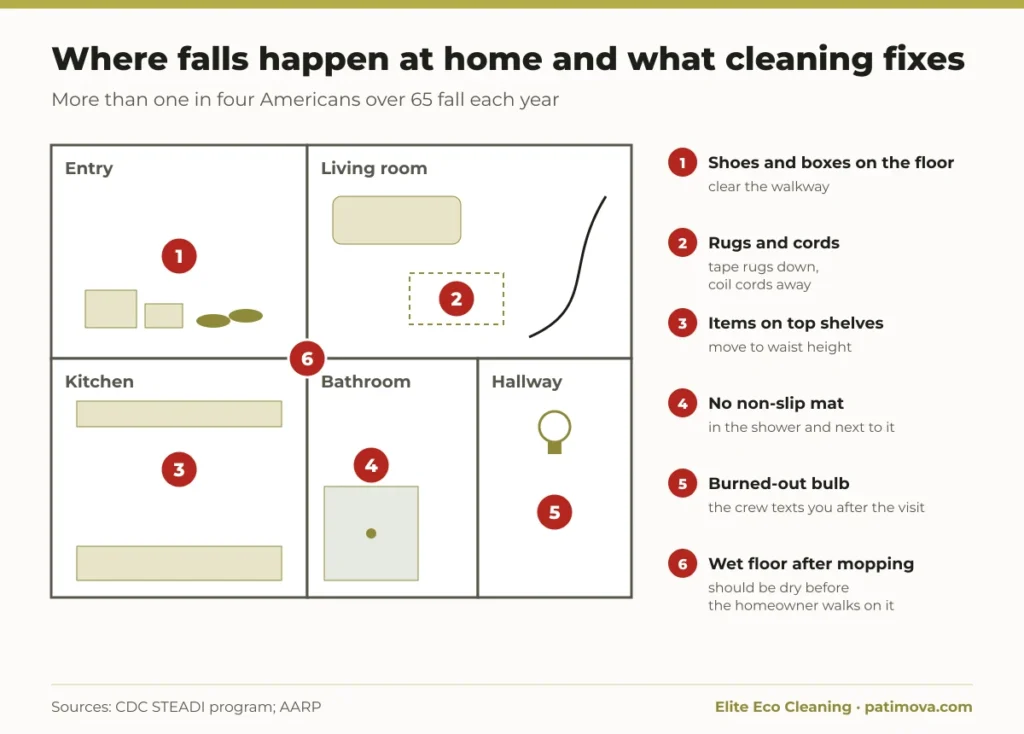
According to the CDC, more than one in four Americans over 65 fall each year. Falls among older adults lead to 4.5 million emergency room visits a year and 319,000 hospital stays for hip fractures. They are the leading cause of injury deaths at that age. Regular cleaning removes part of the risk.
Floors and walkways
The CDC STEADI program recommends keeping walkways clear, removing small throw rugs or securing them with double-sided tape, picking up shoes, papers and boxes from the floor and coiling cords out of the way. After mopping, the floor should be dry by the time the homeowner starts walking around. AARP stresses this rule for cleaners who work in older people’s homes.
Kitchen and bathroom
Things used every day get moved to waist height so nobody has to reach up or stand on a chair. The bathroom needs a non-slip mat in the shower and one next to it. A handyman installs grab bars, but a cleaner can point out where they’re missing.
What a cleaner notices
Someone who comes every two weeks sees the house with fresh eyes. A burned-out bulb in the hallway, a curled rug edge, a puddle under the sink, spoiled food. Ask the crew to text you about things like that after each visit. A cleaner won’t change a ceiling bulb that can’t be reached from a two-step ladder, because our insurance doesn’t allow it.
Who pays for cleaning
Articles about cleaning for seniors rarely cover this, even though it decides how much the family ends up spending.
Medicare
The Medicare website says plainly that the program doesn’t pay for homemaker services like shopping and cleaning unless they’re related to a medical care plan. Original Medicare won’t pay for weekly cleaning.
Medicare Advantage
Some private Medicare Advantage plans include extra in-home support services. Milliman counted 794 such plans in 2023. Whether your parent’s plan has this benefit is listed in the Evidence of Coverage document, which you can request by calling the number on the insurance card.
IHSS in Los Angeles County
California’s In-Home Supportive Services program pays for in-home help for people who are 65 or older, blind or disabled, qualify for Medi-Cal and live at home. Covered services include cleaning, changing bed linens, laundry, cooking and shopping. Los Angeles County takes applications at 1-888-944-4477. Domestic tasks usually get up to six hours a month under the program. Families pay for deep cleaning or weekly cleaning of a large home on top of that.
| Program | What it pays for | Who qualifies | Where to check |
| Medicare | No cleaning unless it is part of a medical care plan | People enrolled in Medicare | medicare.gov |
| Medicare Advantage | Some plans include in-home help | Members of a specific plan | Evidence of Coverage document, insurer phone number on the card |
| IHSS | Cleaning, linens, laundry, cooking, shopping. Domestic tasks usually up to 6 hours a month | People 65+, blind or disabled, eligible for Medi-Cal, living at home | Los Angeles County applications: 1-888-944-4477 |
How to arrange cleaning if you live in another city
Your parent doesn’t need to call, schedule or pay. You can do all of it remotely.
Booking and payment
Book through WhatsApp, SMS or the form on our website, with your parent’s address and your own phone number for updates. Payment is on the day of the visit by card, Zelle or Venmo, cash isn’t required.
Access to the home
If your parent will be home, remind them about the visit the day before and on the morning of the cleaning. An older person may not open the door to strangers, and after 30 minutes the visit counts as missed and is charged at the minimum. If your parent is in the hospital or away, leave a key in a lockbox or with the building manager.
Updates after the cleaning
Ask the crew to text you after the visit with a couple of photos of the kitchen and bathroom. We take before and after photos only for the report, and they are never published without your written consent.
How to avoid hiring scammers
According to FBI data cited by AARP, Americans over 60 lost $7.7 billion to fraud in 2025, 60% more than the year before. Anyone who holds a key to the home of a parent who lives alone should be vetted more carefully than anyone else.
Red flags
Cash only, no company name or address, no certificate of insurance. Asking to pay for several visits in advance. A cleaner who offers to work off the books for less. Questions about money, pensions or banks. Any one of these is a reason to stop.
What to put away before the first visit
Documents, checkbooks, bank cards and cash go in a safe or leave with you. Gather medications in one spot so the cleaner doesn’t move them, otherwise your parent may not find the right bottle later.
Dementia and hoarding
When a parent has dementia or hasn’t thrown anything away in years, cleaning needs a different approach. Rushing does more harm here than dirt does.
The same person at the same time
The Alzheimer’s Association writes that a predictable routine and calm activities reduce anxiety in people with dementia. Cleaning on the same weekday at the same hour becomes part of that routine. AARP suggests that a family member stay nearby or reachable by phone while someone with dementia has their home cleaned.
Nothing gets thrown out without consent
For a cluttered home, agree in advance that the crew cleans around belongings and throws out nothing except obvious trash and spoiled food. Sorting things should happen together with your parent and a little at a time. A one-day clear-out often ends with the person refusing to let anyone into the house at all.
Elite Eco Cleaning team comment
With older clients we work without long-term contracts, and the schedule adjusts to your parent. We do light cleaning, mop floors and clear away anything someone could trip over. If a client likes their cleaner, we try to send the same person to every visit after that, because a familiar face at the door means a lot to older people. Our products have no harsh smells, which makes cleaning easier for people with asthma or chronic lung disease.
Добавить комментарий